Wednesday, June 17, 2020

Summer 2020

Another growing season


I started the hazelnut seedlings in the first week in March, which happened to be a little early and caused them to be too tall and lanky. This was due to the cool spring and not being able to move them outside or in the greenhouse without heating it continuously.


I usually stratify about 400 hazelnut seeds and out of those about 160 plants will germinate, but this year over 300 of those seeds germinated. I found that this is the max for the space I have to start seeds.


I started running out of room and stacking them anywhere there was room under the lights.


Finally it was warm enough to move the plants into the greenhouse with minimum heating at night, and I started using the solar panels to run a temperature sensor and fan. 


After moving the all the plants to the greenhouse it was completely filled.
 I actually had no idea how many plants I had until I moved them.


Even with all the hazelnut seedlings in the greenhouse, I began starting my garden vegetables and flowers.
I was surprised how much better the tomatoes and squash did in the greenhouse compared to trying to start them in the house. They are a little hard to see in this picture, but they are on the top shelf, far end. 


This spring the hazelnuts flowered about 2 weeks later then usual, on the 25 of April. 
They have been flowering the first week in April the past few years. I have found that hazelnuts flower after 2 consecutive 60ΒΊ days. 
The picture above shows both the male catkins on the right and the female stigmas showing on the bud on the left. 


This is another picture of a female hazelnut flower in the center of the picture.
I was trying to hand pollinate several plants, and found that female flowers only last 2 days before the buds began to swell and cover the stigmas. I did manage to get 3 plants hand pollinated.


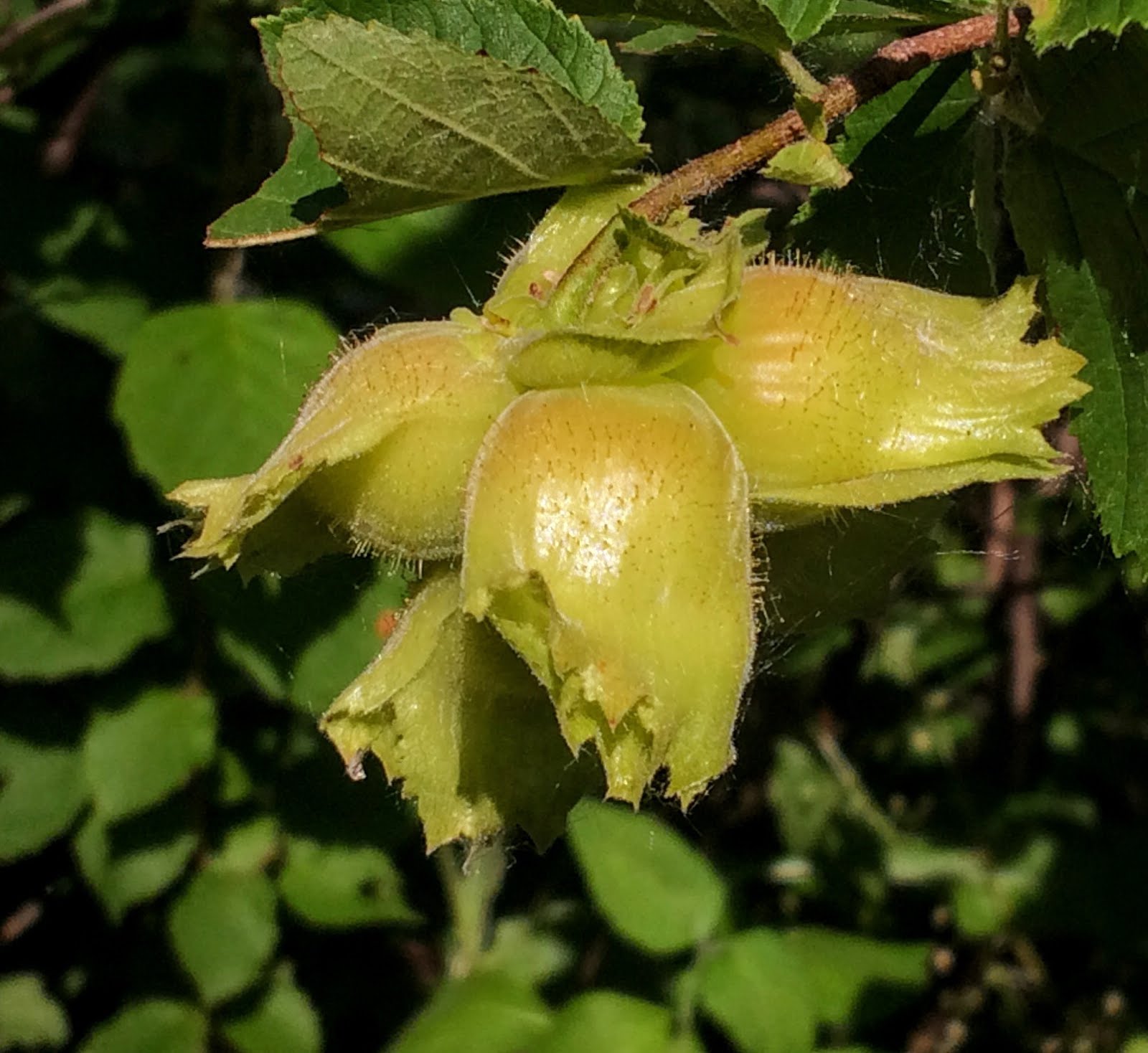
This is a developing hazelnut cluster in the center of the picture on June 2. The cluster will usually contain 3 to 4 nuts.


On June 16 this new hazelnut cluster of 5 nuts has doubled in size.


These are the 1 year old plants that are for sale that have just leafed out.


Rabbit Damage


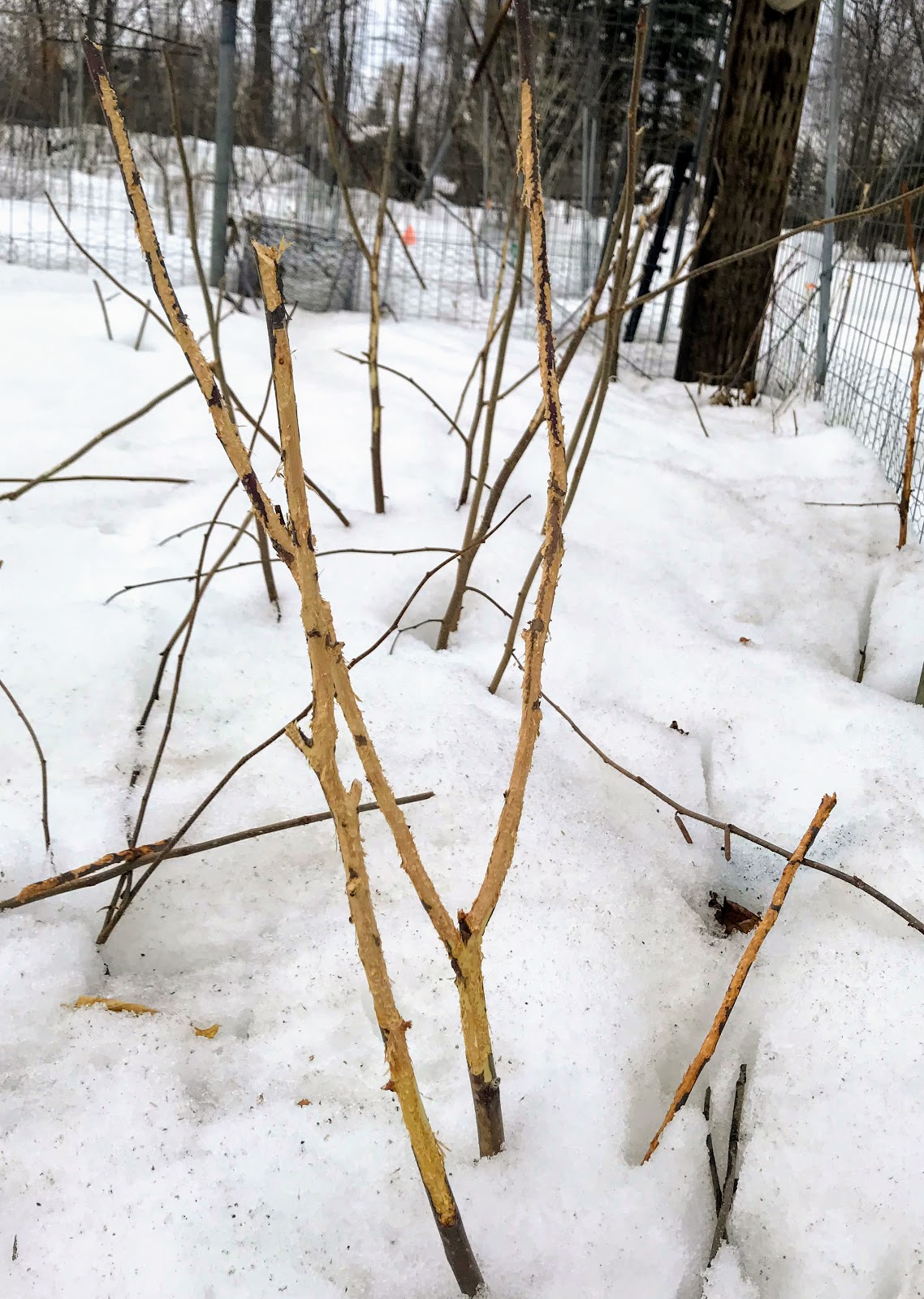
This last winter I had severe rabbit damage with the high level of snow in the orchard.


This is the look of the orchard now after regrowth. The hazelnut plants should be about 8 feet high, but most of the plants are only a little over 4 feet high.  As you can see the rabbit missed a few plants. Next spring I will have to do a lot of pruning to obtain more of an upright structure then a low lying bush. 


Tuesday, March 10, 2020

Propagating hazelnuts 2020

Seedlings 2020


These are seedlings that I started on the 26-Feb-2020. The seedlings are usually started the first week in March, but I wanted to try germinating some the last week in February to see if there are any advantage to starting them a little earlier.


These were started the first week in March, and it looks like most will be up in a week.


Here is a close-up of the some more seedlings.


I have a red leafed hazelnut (Rosita Filbert) that was just bought from Sheyenne Gardens in February. The tag list it as Zone 3-9 from Oregon State University, but OSU lists the hardness Zone as 5a-8b. Adam Volz from Sheyenne Gardens had already informed me that it was not hardy in this area, and the tag was wrong, but I couldn't pass up those red leaves. 
It started blooming and leafing out, so I hand pollinated it with pollen from my hazelnut plants, which I had stored in the freezer. This plant is not hardy for our area, but it will be interesting to cross it with my hardy hybrid plants to try for a red leaf variety.


Rabbit Problems
πŸ‡πŸ‡πŸ‡


This is the first year that I've had major problems with rabbits. They manage to get through the fence the past 2 weeks and damage over 62 plants.


I've been checking the orchard all winter and most of the damage was just done the last week in February .
It looks like this year I will have a few less nuts to pick. 


Here is more damage, but this hazelnut plant is outside the orchard fence. This plant which is close to house and I can see it from the windows was chewed up in one night.


The fence consists of a 6 foot fence with 1 1/2 inch spaced wire with 2 feet of poultry fence (chicken wire) around the bottom.  As you can see in the picture the poultry fence is buried under 3 feet of snow, and the rabbits must be able to hop right through the deer fence.
This summer there will be 2 more feet of poultry fence added to the orchard's deer fence.


I also have some apple trees that where grown from seed and grafted with better types of apples.
They are completely fenced off and the trunks where wrapped 3 feet up. 
Somehow the rabbits got thought the fence and did this in one night.
There was one tree in the back that was not stripped, so I immediately wrapped it up another 3 feet.
The apple trees here where probably planted a little too close together but I was just using them to practice different grafting techniques. I had ten different types of apples grafted on these 15 year old trees. 


I had this special oak that I started from seed 5 years ago and that was stripped as well.
One interest thing is after checking the hazelnut orchard all winter is that I've never seen a one rabbit.


This is a Trader Mulberry from Jim Walla (Northern Tree Specialties).
Every plant around this tree was damaged including the spruce tree to the left but the rabbit did not even nibble on the mulberry. 
The tree was almost bent over and touching the ground after the heavy snow last fall, and it popped right back up after I shook off the snow. 
It looks like I might have to prune some of the lower branches this spring because that rabbit just wasn't up for it.
I'm really impressed by Jim's Trader mulberry, rabbit proof and unbreakable.
πŸ‘ 


Monday, January 27, 2020

Hazelnut Evaluation, 2019

Nut sizes


Every year I do a hazelnut evaluation on the nuts from each plant. The evaluation includes the size, thickness of the shell and taste. Also included in the evaluation is any interesting things about each plant such as structure of the plant, any disease or pest problems, and if the plant should be removed or pruned.
The picture about is the different sizes ranging from the larges to the smallest grown in 2019. 


This is a closer look at the different variations of the hazelnuts.


Problems in the 2019 crop.


The hazelnuts that matured later in September did not fill out, as you can see in the picture above.  The smaller nut to the left was a nut that did fill out, but it matured earlier and was picked in the middle of August .
The loss of nuts on these 5 late season maturing plants which have some of the largest nuts in the orchard was really baffling and a disappointment.


These pictures are nuts from different plants in which the nuts mature in late September and did not fill out. The kernels above on the left are another one that did not fill out, and tasted like cardboard. The kernel on the right is a full mature kernel.


On this plant the kernels were small and stuck to the top of the shell.

I brought some of these nuts into NDSU and had Greg Morgenson look at them. He told me they looked like they needed more heat units during the summer.
I found that heat units are the seasonal heat accumulation which is measured using growing degree days or GDD. A higher accumulation of GDD indicates a greater total quantity of heat during the growing season.
The nut crop was good in 2018 with a GDD of 2600, and the GDD for 2019 was just 2146, which is a  little short for recommended GDD of 2600 to 2700 for nut crops.
I originally thought it was lack of moisture, but the late spring and cool wet fall disproved that.
With the wide variety of hazelnut plants in the orchard, it was only a small loss of nuts but still a big disappointment.  This also gives me a better indication of which plants to select in the future.


I also found 6 of my new 4 and 5 year old plants with Easter Filbert Blight (EFB).
My policy is to remove the affected stems as shown above and burn them. If the plant is also producing small or inedible nuts, the whole plant will be removed.
My goal is to just select plants that are resistant to EFB.


Starting to see more weevil damage this year, and have to investigate a better way to control them, and that might be some type of spray. Right now I try to pick the nuts as early as possible and then collect the weevil under the drying racks when they bore out of the nut.
.


This was another surprise when the squirrels started removing nuts on the 19th of  July, but the hot pepper spray worked good and I bought 2 more live traps. 


This is my son Bryce and grandson Orion inspecting the orchard this winter.
I'm looking forward to spring 2020.


Saturday, November 23, 2019

A Little Hazelnut History

Do hazelnuts grow in North Dakota? You may be surprised learn that hazelnuts are a native shrub that grows naturally in both North Dakota and Minnesota. They might even be growing near you.
I read that hazelnuts were some of the first plants to colonize this area after the glaciers melted about 10,000 years ago. I was a little skeptical at first, but after finding hazelnuts in so many places in North Dakota, and the fact that each plant had such different characteristics. Some were very short about 3 feet high while others were over 15 feet high and the husk which covers the nut on some are a smooth leaf like structure and others have a very fat, juicy husk with little hairs.  Some are growing in heavy high ph soils, some growing in sandy dry soil, and some growing in low ph bogs with blueberries. For the same plant to occupy so many different types of locations it must have taken many years to adapt to all these different types of ecosystems.
Officially there are two species of hazels native to this area, the American hazelnut (Corylus Americana) and beaked hazelnut (Corylus cornuta).


This is one type of American hazelnut that I've found in the northern part of our state.
It was about 4 feet high and had a leafy type of husk with 2 or 3 nuts in each cluster.
This plant is a multi-stem suckering shrub and the stems are usually less then 1/2 inch thick.
This one plant can take over quite a large area, and is probably something that you would not want in a small garden.


The small green cylindrical columns hanging from this American hazelnut branch are catkins (male flowers) that develops on the plant in the late summer and will open the next spring to release pollen for the female flowers on the neighboring plants. Hazelnuts are not self pollinating, so two or more plants are needed for a good nut crop.
On this plant a single catkins hangs underneath each leaf node. I've found most wild hazels in North Dakota have this characteristic of single catkins, which is unusual because most other hazelnut varieties have multiple catkins hanging from one leaf node.


This beaked hazelnut is usually found as a understory shrub located around some lakes in low ph sandy or loamy soils. The nuts have a long hairy beak like husk, which can irritate your hands when picked. They usually are in cluster of 2 but I've also seen them in clusters of 4. The nuts are small with a thin shell with a fair taste.
The leaves of both types of hazelnuts are very similar being alternate, simple, with double toothed margins. As you can see the best way to identify which type is by the husk or the catkins. 
I've tried growing these beaked hazels in heavy high ph soils in this area of the Sheyenne River and have only managed to grow just the one shown above. 


These are the dual catkins of the beaked hazel, and are always pointing in an upwards direction.
This makes identifying a beaked hazelnut during the late summer, fall, and winter very easy.


The female flowers of both hazels are really hard to tell apart, except for the fact that beaked hazelnut blooms a week later then the American hazelnut. 


The big differences of the American hazelnuts have really fascinated me. This plant was growing in an open area in the Sheyenne Grasslands south of Leonard ND and is over 15 feet tall and with stems that are over 2 inches thick.


The fruit of this hazel that grows in this open area has a fat and juicy husk around a thick shelled nut.


I found hazels growing south of Valley City in small state park with a creek. The trees in this area are mostly oak. Some of the under story shrubs are choke cherries and hazelnuts with buckthorn taking over parts of the under story. 


Here I'm investigating the hazelnuts on the edge of this wooded area in the park. Most of these plants were about 5 feet tall and produced large amount of nuts every year. I assume that the squirrels concentrated on the large amount of acorns that ripen earlier then the later thicker shelled hazelnuts.


These are the hazelnut from  Little Yellowstone Park.
The husk on these are almost perfectly round, and juicy.
It has a medium sized nut with a thicker shell then most American hazelnuts, and the taste isn't too bitter.


These hazelnuts growing in Oregon are European hazelnuts (Corylus avellana) and would be multi-stem shrubs but they remove the suckers and are trained to grow as small trees. 
There are also hazelnuts that grow as a large sized tree called a Turkish tree hazelnut(Corylus colurna). These 40 to 50 foot trees produces low numbers of small nuts and takes 7 to 10 years to produce nuts.


This European type of hazelnuts is one of the larger nuts that drops out of the open husk when ripe. They are then swept up off the ground, washed, and processed. 


These are the catkins from a European hazelnut. 
These type of hazelnuts always have multiple green catkins hanging from one leaf node.


Easter Filbert Blight (EFB) is a fungi that affects most European hazelnuts which have little or no resistance and usually succumb to this disease in 2 or 3 years.
Most American hazelnuts are resistant but will carry EFB.  There are now a few universities and other groups crossing hazelnuts from around the world to find a resistant verities of plants with these same large nuts.
Almost all of these European hazelnuts are not hardy enough to grow in North Dakota.


I started an orchard near Horace, ND in 1978 with some native American hazelnuts from Northern Minnesota and later added collections from elsewhere including the Sheyenne Grasslands. I then purchased some hazelnuts with the European back ground including some three way hybrids. Almost  all of these did not make it through our winters, but a few did and with that genetic diversity I began picking and growing out nuts with a larger size, thinner shell, and the better flavor like that of the European filberts, but with the cold hardiness of the American hazelnuts.
I also began picking other traits such a non-suckering, more of a tree like structure, and a plant in which the nuts could be easily removed from the husk.
I also found that some of these new varieties were not resistant to Easter Filbert Blight and I lost some of my best plants. Now EFB resistance has become another trait I'll have to consider.
The hazelnut in the picture above is one of my plants with more of a tree like structure, but does produce one or two suckers every year. Even more important is that it's resistant to EFB.


My latest projects are hand pollinating and cloning some of my best plants.
The hazels in this picture are all either hand pollinated or clones, and this spring almost all will produce nuts for the first time. 


This is not a hazelnut but the nut of a buckeye. 
I thought you might what to see something another then hazelnuts