Saturday, June 25, 2016

Birkemier Farms tour

We were in Oregon for my daughter's graduation. Kelsey helped arranged a tour of Birkemier Farms, a large hazelnut orchard and nursery.  


Thanks Dr. Kelsey Sondreli. 


Loren Berkemier in the brown shirt gave us a very interesting tour of their hazelnut nursery.  He showed us the different types of cultivars that they are propagating. Loren informed us that they receive new introductions from Oregon State University Hazelnut Breeding Progam to test and propagate. Their main concern is resistance to Eastern Filbert Blight, which has affected a lot of their better hazelnut cultivars.


They do most of their propagation using a cloning method called layering. Layering is tying off the new immature hazelnut shoots and then adding a foot of compost for root development.  They can produce 4 to 6 from each layered plant. 


As you can see here they have many layered plants. Plants can also be propagated by tissue cultures done at a lab. The tissue culture "plugs" are then planted at the nursery.  The layered plants produce nuts in just a couple years whereas the plants started via tissue cultures take 4 to 5 years.


This cultivar has just been planted and will be layered next year. 


There hazelnuts are about 3 months ahead of the ones I raise in North Dakota.
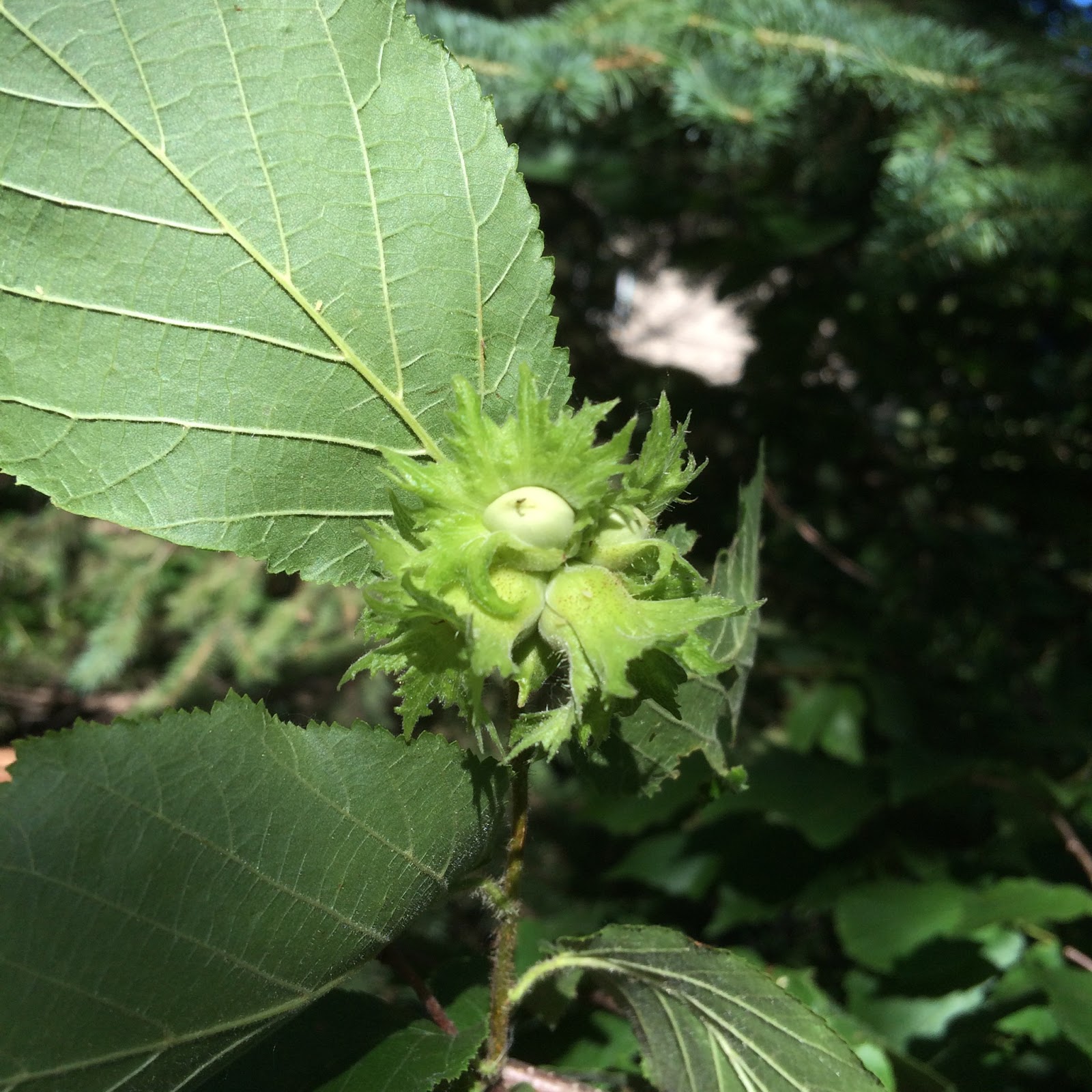


This is the new hazelnuts in my orchard.


These hazelnut clusters are a wild varity from northern Minnesota. In this picture you can see the husk is very thick and encloses the nut.  This makes it hard to dry down and remove the nut.


This hybrid cultivar here has only a single nut, but it is easily removed from the husk.


This hybrid plant has a large cluster of nuts that are easily removed from the husk and will fall to the ground when ripe.


This cultivar also has large clusters with larger nuts that are easily removed.


Here you can see a mature hazelnut orchard in Oregon. The small tree at the right was planted to replace a plant that affected by EFB. The ground is very flat and was being graded while we were there. This is done to allow a mechanical sweeper to pick up the nuts when they fall to the ground.


Loren gave a fantastic tour and was very informative. With this new information I'll be doing a lot more cloning by layering of my best plants, but still breeding for a better hazelnut.
The Birkemier Farms link is http://www.growinghazelnuts.com


The Berkemier Farms also are testing Honeyberries (Haskap) at their nursery. 
The berries were ripe and very good!
They may start propagating next year for the Oregon area.


I had to put this picture of Nancy and me with the new Doctor of Botany and Plant Pathology.
Good luck Kelsey!


Saturday, April 2, 2016

Spring Clean-up & Pollination

This year's spring clean up mostly involves cutting down the unwanted hazelnut plants.


Here I am cutting down about 102 inferior hazelnuts before they can pollinate the rest of the orchard.


The picture here is from the rabbits pruning the higher quality plants.

This is something I don't really appreciate!


Hazelnuts are monoecious wind pollinated species that flowers in March.
The next pictures show the male (catkins) and female (stigmas) flowers


These are the catkins (male flowers) that form in the fall and produce the pollen in the early spring.
This also helps in identifying hazelnuts during the winter and spring in any location.


This is a close up of a typical catkin before it begins to elongate.


In this picture the catkin has grown to twice its length, and is about to release the pollen.


To hand pollinate hazelnuts I first collect the catkins, and spread them out on clean white paper in a warm room and leave overnight. The next day I shake the catkins to extract the rest of the pollen.


I remove the catkins from the paper, fold, and pour the pollen into a small plastic vial.


Here are the vials from some of the best selected plants.


This is the tiny red female (stigmas) flower on the end of the bud.
To hand pollinate these flowers I place a fingertip over the inverted vial to coat the end of the finger.
Then carefully touch the stigmas and coat it with a light coating of pollen.


Part of the hand pollinating process in the spring is to remove the catkins from the plant that you have selected for the breeding program and cover with a bag.
Right after a rain or when most of the pollen has been released from the catkins I remove the bag, hand pollinate the stigmas, and place the bag back over the plant.


Riverbend Hazelnut improvement program
  1. In the breeding efforts maintain large diverse populations of genetic resources.
  2. During open pollination, inferior genotypes are naturally eliminated by harsh climate of North Dakota, culling, and the presence of EFB.
  3. Superior seedlings are identified and nuts harvested to plant successive generations, which then undergo similar evaluations.
  4. Nut evaluations are good taste, thinner shell, larger nuts, higher kernel percentage, and those that fall from the husk on maturity or easily removed form the husk on maturity.
  5. Plant evaluations are non-suckering growth habit, extreme cold hardiness, early maturity, seedling precocity, disease and pest resistance, and tolerance to various stress (dry, wet, and soil ph).
  6. Some traits that may help in selling the plants are red leaf color, leaf shape, growth habit, and the shape of the husk during the summer.
  7. My hope is to increase the potential for the usefulness of hazelnuts in this area.
  8. Cloning and controlled crosses are next.


Saturday, March 26, 2016

Growing Hazelnuts from seed in 2016 & Plants for Sale

Growing hazelnuts from seed is fairly easy. The process involves stratifying (cold period) and germinating the seed.


There is an easier way to grow hazelnuts from seed.  Plant the nuts in garden rows in the fall. They will germinate the first week of June. They can be moved to a permanent location in the fall right after leaf drop or in the following early spring. I've done this and lost most to squirrels, chipmunks, mice and would you believe raccoons too! You must protect them when outside!


I prefer to use this method to stratify and germinate hazelnuts.

Soak the nut in water for 12 to 24 hours to rehydrate the nut. I usually soak the nuts for about 16 hours. Then pack in plastic bags in slightly moistened (not wet) peat moss. I use peat moss because it inhibits mold and fungus. I have used damp paper towels, but lost most to mold.
This year I'm trying a hot-water seed treatment for disinfecting the surface in which I might not need the peat moss. My thanks goes to Scott Pahl of Germains seed technology.


I then stratify in the fridge at 34º F to 40º F for 4 weeks or up to 4 months. If the temp is below freezing the stratification time stops.


Remove from refrigeration and soak in 80º F water for 10 minutes and place the nuts between damp paper towels in a plastic container. Try to keep the nuts slightly separated. During this period I keep the nuts at room temperature. They will not germinate if below 50º F.


These are some of the plastic containers I use. There are about 50 nuts in each container.
I usually start this process in the first or second week in March.


In 2 to 4 days the shell will crack and the radicle will appear. I then place the germinated nuts in 6 to 8 inch deep pots with a well drained potting mix or sometimes use a mix 50/50 with sand, and that seems to work. I did this because I was low on the potting mix.

I have planted directly into the garden right after refrigeration if the soil temp is around 50*F, and that works. Remember to protect the nuts. I plant to a depth of 1 inch out side, and 1/4 inch in the pots


In this picture the hazelnuts are 5 days from removal of cold storage.


The plants here are now 10 days old, and almost all have their major leaves.
From middle of April to the beginning of May I gradually move them outside.

I have over planted again this year, and do not have room for so many plants, so I will have seedlings for sale this year.  I also have about 100 one year old plants for sale.


Thursday, February 11, 2016

A winter birds eye view from a drone

The drone pictures of the hazelnut orchard are taken by Bryce Johnson


The hazelnuts are located in 3 rows along the river by the spruce trees. We've had to fence off these due to beaver damage. If you look closely at one of the spruce trees it has almost no needles due to a needle cast disease. 


The older hazelnuts, which are over 10 feet tall, can be seen between the large ash trees, but there are over 50 smaller plants located in the open area to the left along the fence.


This area has just been cleared of dead elms, buckthorn, and other brush for a hazelnut planting this spring. You can also see Bryce in the red coat, who is controlling the drone. In the background is a fence made of elm trees, and in the center is a dead ash tree that was struck by lighting. This ash is an excellent perch for hungry hawks and eagles. Squirrels and rabbits beware!


On this picture the gate, fence, and grape trellis can be seen, but the hazelnuts here are over 15ft tall and have almost a single trunk.  The nuts from some these will be used for planting the next generation of hazelnuts, and we might have a better nut for North Dakota. 


The hazelnut in the left side of the picture is good tasting, heavy producing cultivar with one trunk. The next step is cloning these good cultivars.


In this sunset picture can you find Bryce by the ash tree?

Monday, November 30, 2015

Hazelnut diseases and insect pests.


  Kelsey Dunnell, who has been an important part of the hazelnut research team, has moved to Oregon to finish her PhD at Oregon State University.  Good luck Kelsey, & you will be missed!!


The picture on the left is Kelsey at NDSU research arboretum near Absaraka, with her hazelnuts research for NDSU. The picture on the right is Kelsey at Riverbend Hazelnuts research area. 


These next pictures are some of the common diseases and insect pests we've had to deal with in this area. 


  This first picture is not a pest, but Kelsey D. showing the effects of EFB (eastern filbert blight).


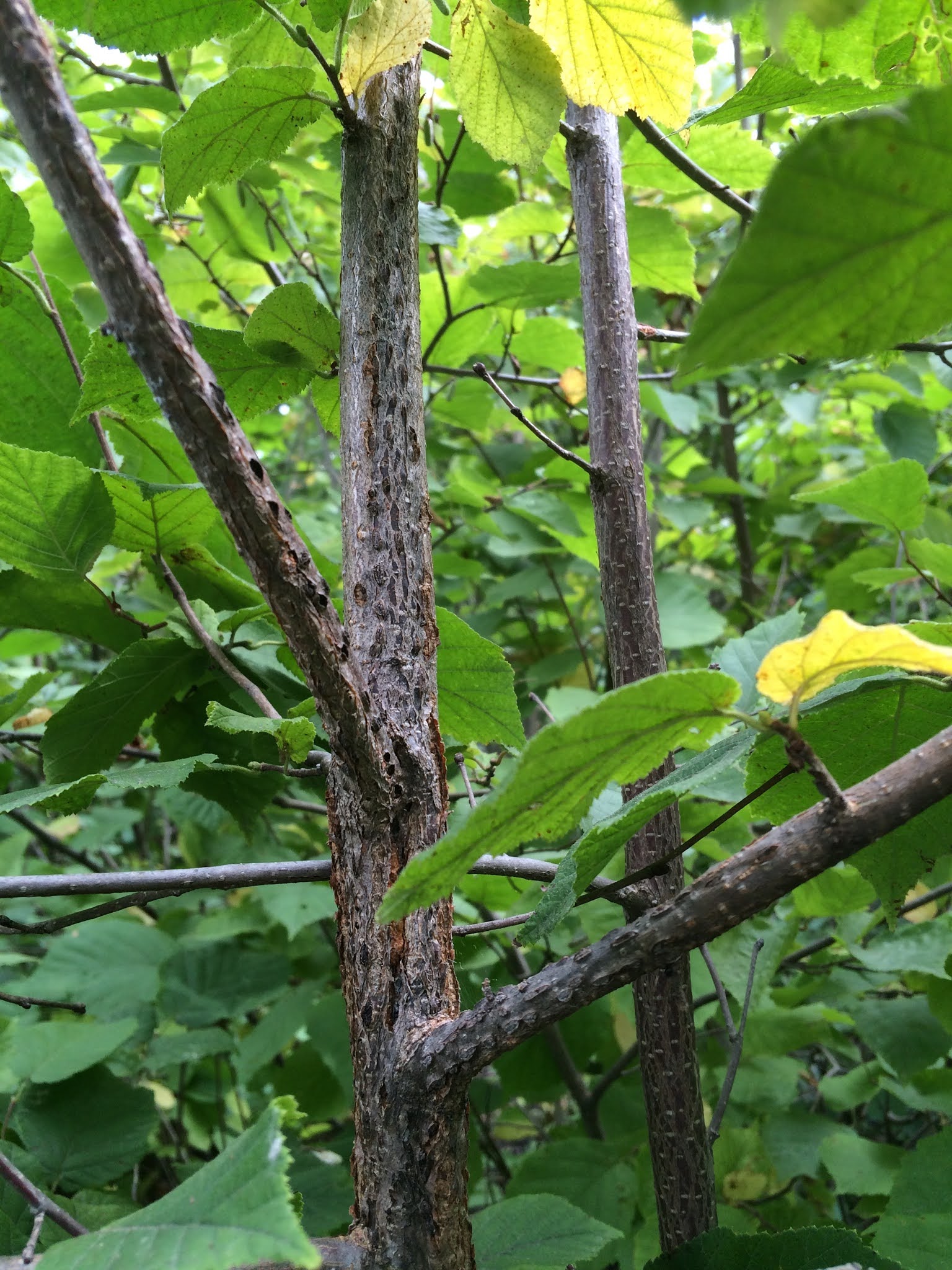
This is a close-up of the branch that Kelsey was holding. You can see the row of black cankers of fungus, and the dried area of the branch. This disease is called Eastern Filbert Blight (EFB).


This affected part of the hazelnut has almost decimated the whole plant with EFB. 


This is another picture of a branch with EFB.


Can you spot the EFB on this horizontal branch?
This blight was first found by Kelsey during the annual inspection, and positively identified by Jim Walla - Tree Doctor of Northern Tree Specialties.  Jim also suggested removing and burning the infected branches before spring to help keep EFB under control.  His help is greatly appreciated.
My hope at Riverbend Hazelnuts is to breed a hardy EFB resistant plant with a tasty, large, and thin-shelled nut that grows in this area.  Right now we have several plants that almost meet all of these requirements, but there is always room for improvement.  

These are some of the new resistant varieties that have just started  producing nuts.
                                   
This is another exceptional plant that has just started producing high quality nuts, and it shows no signs of EFB.
Note the size of the plant against the 7ft fence behind it. 


Hazelnut Weevil, photo by Entomart, Belgium

In the past couple of years this pest has started raising his little head. This insect is called the hazelnut weevil. Originally I thought they where the same as the oak/acorn weevil, but found that they are a specific species that just affects the hazelnuts. I have no idea where they came from because the nearest wild hazelnuts are over 30 miles away, so they must have a good nose to smell the nuts from that distance.


These are some of the nuts affected by the weevil larva.
The weevil larva tends to leave the nut a few hours after it has fallen 
 to the ground, so I try to control the weevil without a pesticide by picking the hazelnuts as early as possible before the larva bores out of the shell, and then dry the nut and husk down inside on a drying racks with trays underneath to catch the weevil larva.  This year I did find some larva that had already bored out of the nut while still on the plant, so I might have to change my tactics and use a pesticide. Right now I feel that by keeping all the hazelnuts picked and cleaned off the ground I can control this pest.  I estimate that this year I have a lost 1 to 2% of the crop.