While visiting our daughter in Corvallis, Oregon in the first week in March, we toured some of Oregon State University's greenhouses and test plots. I found it very interesting, especially the hazelnut plant research, and thought it would be interesting to show some of the things we've seen on our trip.
Oregon State University
We first toured the hazelnut test plots that OSU uses for testing their fruit and nut trees. This picture is of the older hazelnuts, which are most all identical clones. Because hazelnut plants are not self pollinating, they need a different cultivar to pollinate the cloned plants. The pollinator is painted white which is on the right in this picture. There are also a pollinators on every 5th plant in the same row. All of these hazelnuts are in full bloom with pollinator producing large amounts of pollen.
Right beside the hazelnuts where these apple or cherry trees pruned to about 5 or 6 feet high.
I was surprised they pruned them so low. If my apple trees where pruned that low the deer would have nipped the new branches and eaten the apples. I'm wondering if they even have deer in the area.
In this picture the hazelnut plants were planted about 2 feet apart. I was told they were going to be dug up and used for bare root planting.
What have they done to these hazelnuts?
As I looked closer I realized they were mound layering these plants to clone them. It looks like they just removed all the layered suckers.
This green house was filled with this plant. Can you guess what it is?
Here is another look at the hemp that they were growing. Some of these plants were almost 10 ft high.
I don't think I could work in this greenhouse because the heavy smell from the hemp.
I just could not believe at all the new hazelnut plantings in the area.
In this picture the hazels are in full flower and have just been pruned.
I'm guessing these hazelnut trees here are about 3 years old and about half are flowering.
In this field I could believe how large these new planting are, the row must be about a mile long because I could not see the end of the rows.
I noticed some of the trunks painted white to indicated that they must be the trees used to pollinate the rest of the field.
Here you can see the ground is yellow from all the pollen being shed from the hazelnut plants.
I just happened to bring some of the pollen back with me to try to pollenate some to my hazelnut plants. I just wish I knew what cultivars they are.
This is an older field of hazels. I just couldn't believe how flat and weed free the ground is.
It just didn't look right with no ground cover, but in a commercial operation you need it to look like this if the nuts are going to be swept off the ground.
North Dakota Hazelnuts
Back home in North Dakota, my hazelnuts just started blooming on 20th of March which is really early. It's usually been about the first week in April. I also hand pollinated these with the Oregon pollen, and hoping for some Oregon crosses.
Here is a 2 year old clone that was flowering and should produce nuts this year.
Here is that same clone with the catkins (male flowers) and the red stigmas (female flowers) at the end of the buds. These were also pollenated with Oregon hazelnuts.
These are some the new plants that were stratified and just germinated on the 21 of March.
Now we wait to see how the plants overwintered, work on germinating more seedlings, and transfer plants to the greenhouse for spring.
We had an exceptionally warm fall this year, which gave me time to cut down and start removing some of the inferior hazelnut plants. Most of these plants had small, thick shelled, or bad tasting nuts and other plants suckered badly or had EFB (Eastern Filbert Blight).
All the plants you see above are resistant to EFB.
I originally thought it would give more spacing for the better plants, but found that some of these plants were still in groups too close to each other. I prefer 5 ft spacing with 8 to 10 ft between rows, but because of limited space I plant them a little closer.
As you can see in this picture I have some large open areas that will have to be filled with some of my better hazelnut plants.
These are about 120 plants that were cut down.
To eliminate suckers from coming up from the stump next spring, a herbicide is painted on the stump and then covered with soil.
The plant stems that I found this year that were infected with EFB where burned immediately to help reduce the spread of the fungus. The green branches didn't burn very well so I had to add some dry ash logs which did the trick.
Eastern Filbert Blight
The other pictures looked so black and white so I thought some color pictures would look nice and I could explain a little bit about EFB.
In the spring the fungus first infects young new shoots, but does not show up visibly on the branch for the first year. Sometimes I can spot an infected stem in the fall by a flat spot on the stem and a brown color in the flat area when the bark is removed. The picture above is a two year old stem and starting to show the tell tale black cankers in a row going up the stem.
I try to remove the infected stems as soon as possible to reduce the spores infecting other plants.
This plant had EFB for about 5 years before I spotted it.
Some plants produce good nuts but are not resistant to EFB, so I prune any stem that is infected, and also remove all the catkins (male flowers). The catkins are removed to limit the plant passing on its non-resistance to EFB.
Here is a close up of an infected branch that is 3 years old.
If Eastern Filbert Blight is not pruned out every year the hazelnut plant will look like this in 10 years.
Right now there is no fungicide to slow down or kill the fungus so removing the plant with no resistance to EFB or pruning is the only option.
I've started training the new cat to hunt squirrels, but so far he hasn't been able to climb as fast as the squirrels. I wonder if a mink would do a better job.
This year the fall colors on the hazelnuts were better than I've ever seen. With this unusually mild fall the orchard showed its best colors.
In this picture you can see that some hazelnut plants have turned a nice red color. Who needs maples when you can have a bright red hazelnut that also produce tasty nuts.
In the next pictures you can see every plant has a little different coloring
These hazelnuts are the some of the wild plants from southern North Dakota by Lisbon. This is one plant with many small stems and lots of suckers.
This plant with some nice color is a hybrid with few suckers and nice structure.
This is a 4 year old new hybrid with one trunk. It will be interesting to find out what type of nuts it will have next year. I'm hoping for large, thin shelled nuts.
This is another new hazelnut plant that had one major trunk, but was badly damage from rabbits last winter. All the branches above 2 feet where damaged and had to be pruned. This plant recovered with over 3 feet of new growth, but it produced 2 suckers which might have to be pruned off. It also lost all the mature stems that would have produced nuts for next year, so with a little pruning it will be producing nuts again in 2 years.
This is a 15 year old plant that has a nice structure with 5 stems and produces large nuts. The small stem to the right is a new stem that I'm cloning by layering. Next spring I'll remove it from the mother plant if it has a sufficient root system and pot it up. I'll leave it for another year if it has a limited root system. I have found that some types of hazelnuts take 2 years to produce sufficient roots before it can be remove from the mother plant.
This year we had a very poor crop of hazelnuts, but in late summer the plants have produced an over abundance of catkins, which is the male flower that will open in the spring and release pollen for next year's crop. I'm hoping this is an indication of a big crop for next year.
Problems in 2020
The beavers have been busy this year. This is not a hazelnut plant but a Boxelder tree and close to a row of hazelnuts.
Here is that row of hazelnuts with what is left of an oak tree in the bottom of the picture.
A few years ago a beaver did major damage to a row of hazelnuts and now any hazelnuts close to the river are fenced. So if you are planting along a river you must protect your nuts.
This year I thought there wasn't any deer damage but I was wrong.
These next pictures are more damage from a buck who thought he'd let me know he's back.
Fall colors in my back yard where also spectacular this year.
This year the flowering occurred on April 25, is 2 weeks later than normal, and only lasted 2 days before it cooled down and rained. Hazelnuts are wind pollinated and need a week of warm, dry weather for the male catkins to expand to release pollen, and for the small female sigmas to appear on the buds to receive the pollen.
The plants that were hand pollinated did fine, but because of the many different hazelnut varieties in the orchard they need about a week to pollinate all the different flowering times of these various plants.
Some plants had no nuts, but most had few, and one or two had a good seed set. The plants with the most nuts were more of the wild American Hazelnut varieties. This is probably due to fact that they are the first to bloom, and the later blooming hybrid hazelnuts need a longer pollination period.
This shows last year's crop from one plant, which would fill a grocery bag.
This year I've been getting far fewer nuts, just a handful from my best plants.
This is one of my better hazelnut plants that produced a lot more nuts than I expected, but still far less than previous years.
The nuts on this drying rack are another plant that had a lot more nuts also, but ripened late and I had to spray a lot of pepper spray to keep the squirrels off of them to let them ripen up.
This is almost the entire crop of hazelnuts for 2020 drying down in the greenhouse.
Here we have a few of the different size nuts from this year's crop.
As you can see, some of these plants that produce the smaller nuts will have to be removed and replaced with more of the new hand pollinated seedlings.
Repotting Seedlings
In the spring when the seedlings are moved outside they are transferred from the tubes to larger pots. I was little short on potting soil so I used mostly compost mixed with a little purchased potting mix. The mixture was probably a little too hot due to the new compost, and it turned the leaves dark green with burnt edges. In a week some of the leaves turned brown and fell off.
I thought at first it might be some type of herbicide damage, but now I'm sure it was the new compost I was using for potting soil. Lesson learned!
My only hazelnut graft that worked from 2 years ago is still holding and produced 2 nuts this year.
In search of hazelnuts
I found this hazelnut with a leafy type of husk in Spicer MN on a bike path on July 11, 2020.
This American hazelnut was a little different with the open husk and visible nut in side.
As you can see the nut was small with a thick shell.
I found these hazelnut plants while hiking in Glendalough State Park on August 4th.
Hazelnuts found there had a totally enclosed husk that was round, juicy and slightly sticky.
This is a more typical type of American hazelnut husk.
The nut easily roll out of the husk so it was ripe and ready to be picked.
The nut was not round but more of a oval flat shape, which is very undesirable for cracking.
The nut had a thick shell and the kernel was a flat bean shape, and tasted quite bitter.
Pecan trees
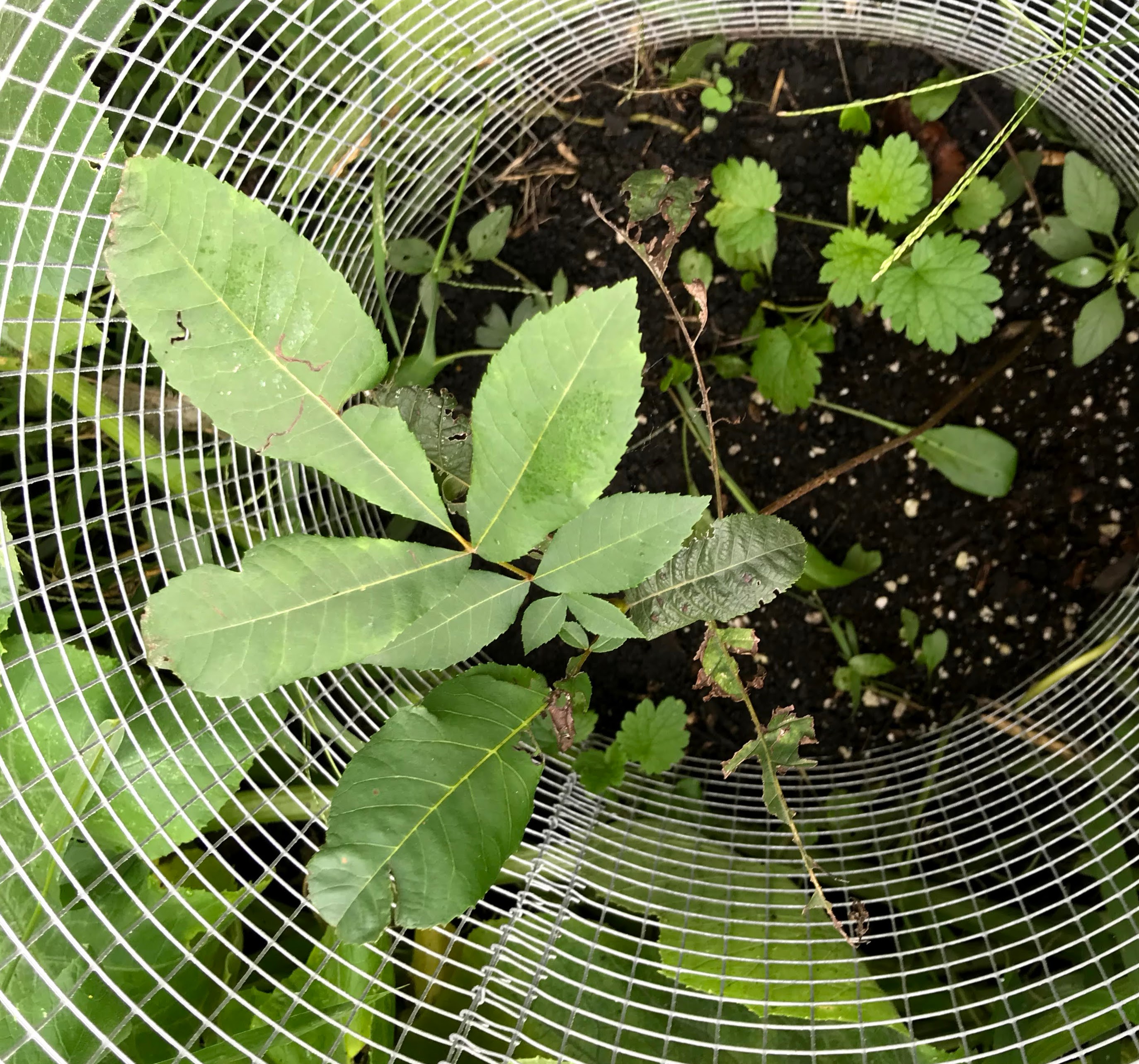
I would like to thank Derek Jundt for the 6 pecan seeds he sent me last year. I stratified them in the fridge and germinated them the first week in March. I was surprised that all 6 seeds germinated, but one didn't make it after transplanting them outside. It will be interesting to see how well they do in our heavier soil, and our winters.
I also received some butternut seeds from Bill Miller in Aneta ND. Only 2 germinated and after transplanting them a rabbit clipped one off before I could put a cage around them, but the one Butternut is looking good.
Thanks Bill!
This is a picture of the last of my 1 year old plants that are for sale.
Cloning using a Hog Ring Pliers
https://youtu.be/2ZcjcGbtp9s
I'm hoping this video that I made of layering using a hog ring pliers works.
This is my first attempt at making a video and it might not be great but I think shows how I clone hazelnuts.